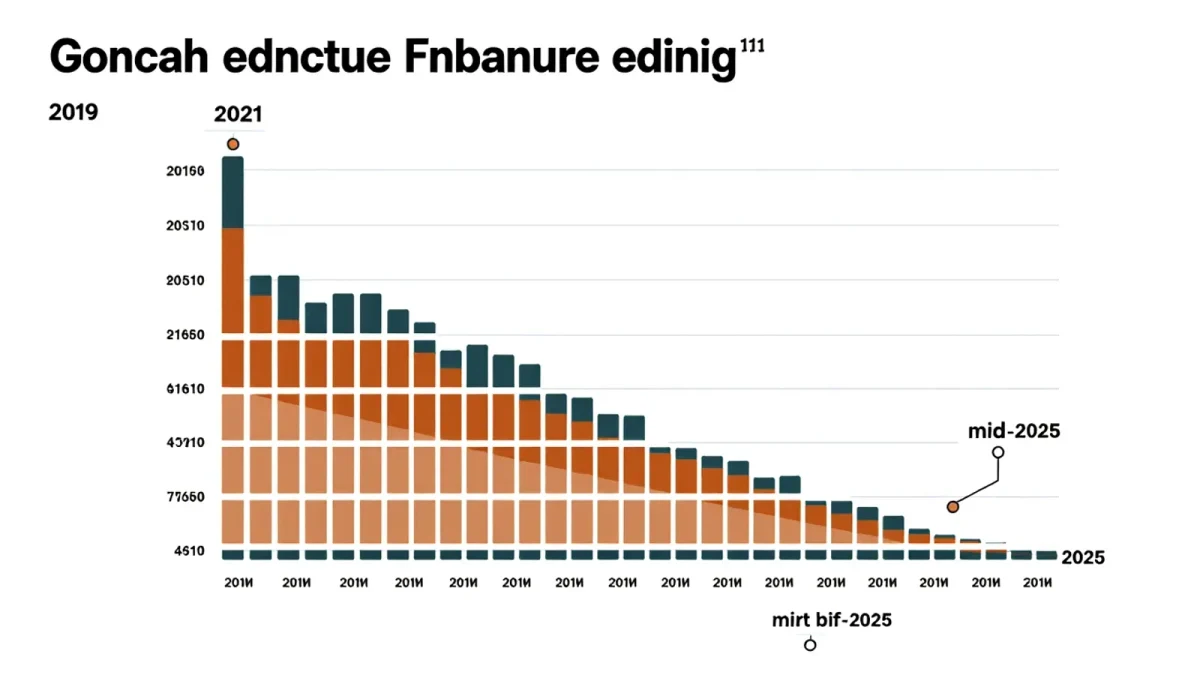
Global education technology venture funding totaled about $1.35 billion in the first half of 2025, per HolonIQ's mid-year tally, a weak midpoint that keeps the sector on track for its lowest full-year haul in roughly a decade. The 2021 boom, when edtech startups raised well over $16 billion in a single year, now reads as an artifact of pandemic-era schooling.
What happened to the money?
The decline has been steady rather than sudden. HolonIQ counted about $410 million in the first quarter of 2025, describing a market with fewer deals but larger individual checks, and estimated full-year 2024 landing in the $1.8–2.4 billion range — the lowest edtech share of total venture capital since around 2010, at roughly 2 percent of all VC investment. First-half 2025 came in about a quarter below the prior year's midpoint, per HolonIQ, with Asia and the Middle East and North Africa region the only areas bucking the trend.
Related stories: Why edtech subscriptions jump in price at renewal · Why district edtech pilots rarely become contracts.
What does this change for schools?
For district administrators, the practical consequence sits in vendor survival math. A company that raised on 2021 assumptions has spent several years unable to raise again, and the sector has already absorbed high-profile distress, including 2U's bankruptcy. Fewer new checks mean fewer new entrants competing on price — but also a thinner bench of challengers to incumbent curriculum and platform providers, and continued risk that tools districts adopted during the funded boom lose support or shut down mid-contract.
For vendors, the investor message has shifted from growth-at-all-costs to revenue quality: multi-year district contracts, measured retention, and procurement-friendly pricing are what late-stage buyers now underwrite. The few categories still attracting larger checks — AI-enabled tutoring and workforce-adjacent training among them, per the same HolonIQ deal notes — are the exceptions that define the rule.
The detail most coverage misses
The venture numbers are not the whole funding picture. HolonIQ separately projects more than $87 billion of global edtech investment through 2030, but that figure blends venture capital with sovereign, philanthropic, and corporate money — and debt. A sector can look starved in VC terms while legacy publishers and private equity keep consolidating it. Districts reading «edtech is dying» headlines should distinguish the two: startup formation is shrinking, while ownership of the tools already in classrooms is concentrating. The practical procurement implication is contract discipline — data-export terms, escrowed content, and financial-health checks on small vendors matter more in a thin funding market, because the rescue buyer that once appeared when a tool failed now appears less often.